Bloody Bastards
- 4.7
- Rating
- 10.00M
- Installs
- Free
- Price
 Analysis by App-foxy
I went into Bloody Bastards expecting a simple medieval brawler, but its appeal became clearer after a few fights: the game is built around the physical feel of each swing, block, and stumble. It is an action game from Tibith, available for free, with a deliberately rough and bloody presentation that suits its Mature 17+ rating. Rather than giving me a large battlefield or a long story campaign to manage, it puts the focus on one fighter, one opponent, and the immediate question of whether my next movement will land cleanly or leave me open.
That narrow focus is important. This is not the right choice if you want a traditional role-playing adventure, a careful historical simulation, or a polished competitive fighter with a large roster. I found it more enjoyable as a quick-play game: start a fight, learn from a mistake, improve a weapon choice or movement habit, and try again. The loop is straightforward, but the unusual controls give it enough personality to make repeated attempts feel purposeful.
How the first fight teaches the game
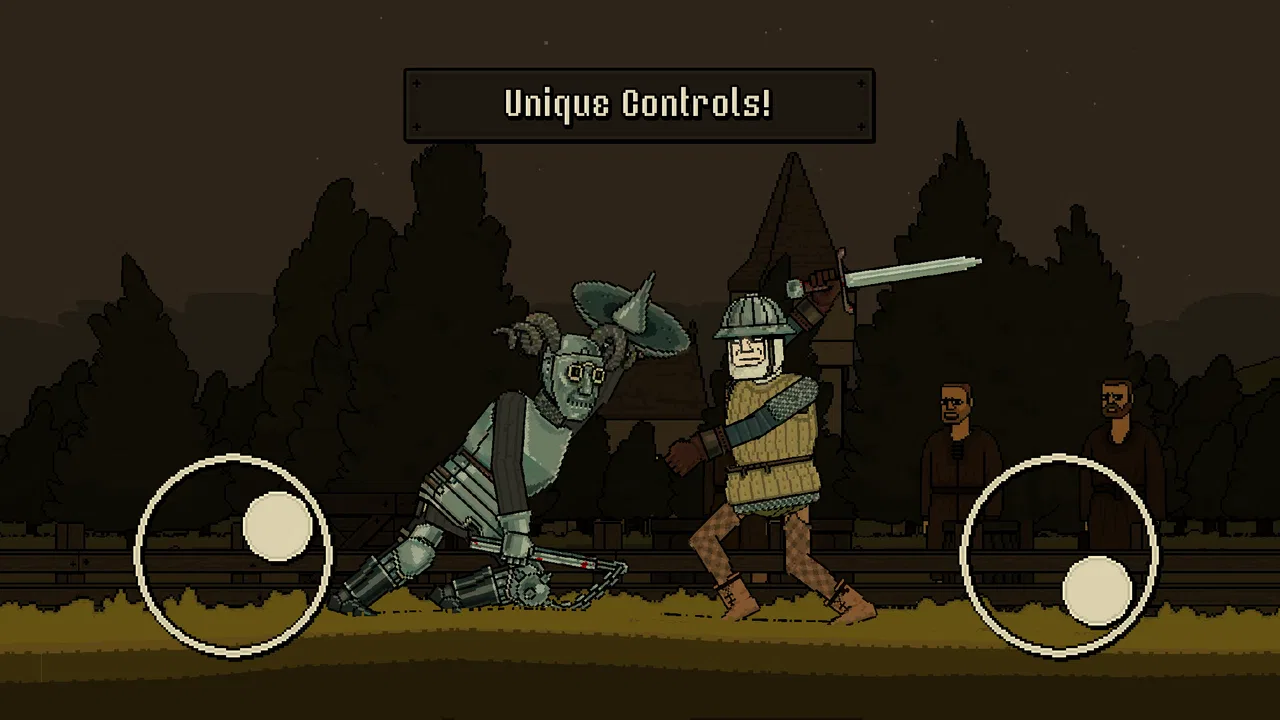
The first action is also the first lesson. Instead of relying on a familiar virtual joystick and a row of clearly separated attack buttons, the game asks me to control the fighter through gestures and directional movement. That makes the opening battles feel slightly awkward, but the awkwardness is part of the design. I am not simply selecting “attack”; I am trying to create the angle and timing of the blow myself.
You May Also Like

 Blood Strike: 2.5 Anniversary
Blood Strike’s Loadouts Turn Every Drop Into a Tactical Gamble
A close look at Blood Strike’s custom loadouts: how fast access to signature weapons reshapes its battle royale rhythm, rewards preparation, and narrows the gap between fights.

 Pandora - Music & Podcasts
Pandora’s Music Is Easy to Start, but Harder to Recover
Pandora’s strength is its low-effort path from a seed to a station. Its weak spot is how much confidence it asks you to place in connection, setup, and quiet recovery.

 8 Ball Pool
 Is Built on Rivalries, Rematches, and Routine
A close look at the rivalries, rematches, shared routines, and unanswered safety questions that turn a quick pool match into a persistent mobile community.

 Samsung Music
’s Quiet Strength Is Playing What You Already Own
Its reach comes less from spectacle than from dependable access to a personal library. That simplicity is both the app’s strongest retention engine and its ceiling.

 AccuWeather: Weather Radar
AccuWeather Review: A Quick, Clear Forecast for Everyday Decisions
For everyday plans, the best forecast is the one you can understand quickly. AccuWeather makes rain timing, radar, and local conditions easy to act on, with a few trade-offs.

 Hill Climb Racing
Why Hill Climb Racing Still Turns Crashes Into One More Run
A tiny car, a bumpy hill and one more upgrade: Hill Climb Racing keeps resurfacing because its simple chaos makes every near-miss feel personal.
More From Our News Desk



That difference gives every weapon a physical character. A broad swing can create useful reach, but it also takes commitment. A shorter weapon feels easier to manage in close quarters, while a poorly timed movement can leave the fighter exposed. The controls are not difficult because the game hides the buttons. They are difficult because they ask me to think about where the weapon is moving and where the opponent is standing.
I recommend spending the opening fights experimenting instead of rushing toward the strongest-looking equipment. The early battles are a safe place to learn how much space a swing needs, how quickly an opponent can close the distance, and when a defensive movement is more valuable than another attack. Players who treat the first encounters as a tutorial tend to get more from the game than players who immediately mash gestures and blame the controls.
The ragdoll presentation makes those lessons easy to notice. A successful hit does not always look identical: bodies twist, weapons connect at different angles, and a poorly positioned fighter can lose balance in a way that changes the next moment. I found that visual feedback more useful than a simple damage number because it showed me why a hit worked or failed.
There is also a welcome sense of directness in the one-on-one format. I rarely wondered whether an unseen teammate or a crowded battlefield had caused a mistake. If I missed, the reason was usually visible: I swung too early, stood too close, or attacked from a weak angle. That clarity is one of the game’s strongest qualities, especially for anyone who enjoys learning a system through repeated practice.
What the unusual controls reward
The best way to approach the controls is to use smaller, deliberate movements at first. Big gestures may look aggressive, but they can make it harder to recover when the opponent steps inside the attack. I had better results when I watched the enemy’s posture, waited for an opening, and used a controlled motion rather than trying to fill the screen with frantic swipes.
This is one of the less obvious strengths of the game: the controls turn positioning into part of the attack. In many mobile action games, movement and damage are separate systems. Here, the path of the weapon matters. That creates a satisfying connection between intention and result, but it also means the game can feel less comfortable on a small screen or for anyone who prefers precise physical buttons.
Touch sensitivity and hand position can affect the experience. I found it easier to play when I kept my grip stable and avoided covering the area where the weapon movement needed to happen. Long sessions can become tiring because the game encourages repeated gestures rather than passive tapping. That is not a flaw for a short break, but it is a real consideration if you want a game to play continuously for an hour.
The feedback rhythm: hit, mistake, adjustment
The core feedback rhythm is immediate. I make a movement, the weapon reacts, the opponent responds, and the fight either opens up or becomes dangerous. A clean strike can interrupt the enemy’s plan, while a rushed attack can produce a clumsy exchange that leaves me scrambling. Because the fighters react physically, even a failed attack can teach me something about distance and timing.
This rhythm is more interesting than a basic tap-to-attack system because the result is not always binary. A blow may connect but fail to create enough space. A defensive action may prevent damage but still leave me in a poor position. I began to judge success by what happened next rather than by whether a single hit landed. That made the combat feel more like a sequence of decisions than a search for one repeated winning gesture.
The ragdoll style also gives the battles an unpredictable edge. The exaggerated falls and impacts are entertaining, but they can make outcomes look chaotic when I am still learning. Sometimes the visual comedy softened a defeat; other times it made a mistake feel especially frustrating because the fighter seemed to collapse at the worst possible moment.
That balance between control and disorder is central to the game. Players who want perfectly repeatable combat may find the physical reactions too loose. I enjoyed the uncertainty because it kept me alert, but I also had to accept that not every exchange would look elegant. The game’s personality comes from that roughness, and removing it would probably remove much of what makes it distinct.
The mature presentation will not suit everyone. The violence is not presented as a subtle historical drama; it is exaggerated, graphic, and closely tied to the game’s identity. I would not recommend it for younger players, and the age guidance of Mature 17+ should be taken seriously by anyone choosing a game for a shared device. Even if the cartoon-like physics make the action feel playful, the bloody imagery remains prominent.
Why defeats can still feel useful
A defeat usually gives me a clear adjustment to try. Maybe I attacked while the opponent still had room to counter. Maybe I relied on a long swing in a cramped exchange. Maybe I focused too much on dealing damage and ignored the need to recover. These are practical lessons, not vague reminders to “play better,” which is why restarting did not feel completely empty.
One useful habit is to change only one thing after a loss. If I switch weapons, alter my movement, and change my timing all at once, I cannot tell which decision helped. Keeping the next attempt focused makes the game’s feedback easier to read. This is especially helpful for new players who initially find the gestures unpredictable.
Another tip is to value control of space over constant aggression. The short fights invite reckless play because the next attack is always tempting. In my experience, waiting briefly often created a better opening than forcing a dramatic strike. The game rewards patience without becoming a slow defensive simulator, since the opponent’s presence keeps pressure on every decision.
Rewards that give the next attempt a purpose
The reward side of the loop matters because action alone would become repetitive quickly. After a fight, I have a reason to think about what I want to try next rather than simply replaying the same exchange. Progress feels most useful when it supports experimentation: a different weapon style, a new approach to distance, or a way to make a familiar encounter feel less predictable.
I would not describe the progression as the main attraction. The combat itself is the reason to stay, while the rewards provide direction. That distinction helps set expectations. If you want a deep character-building system with a long narrative arc, this game may feel light. If you enjoy testing equipment and improving through short battles, the reward structure does enough to keep the loop moving.
The free entry point makes it easy to try without committing money immediately. In-app purchases cost $4.99 per item, so I would advise treating them as optional conveniences rather than part of the basic decision to install. The important question is whether the physical combat feels satisfying to you during the opening sessions. If it does not, buying an item will not fix the underlying control preference.
That is a useful trade-off to understand before spending. The game’s strongest progression is personal: I become better at reading a swing, choosing a moment, and recovering from a bad position. Equipment can make experimentation more interesting, but it does not replace learning the gesture system. Players who prefer games where purchases immediately remove most difficulty may find this less appealing.
For a realistic everyday use case, I can see myself playing it while waiting for an appointment or taking a short break between tasks. One or two fights provide a complete burst of action, and a defeat naturally creates a reason to try once more. It does not require me to remember a complicated story or reconstruct a large map. I can put it down after a battle and return later without feeling lost.
At the same time, the same design can become repetitive during a longer commute or an extended session. The one-on-one format keeps the action readable, but it also limits variety compared with a larger action game containing exploration, missions, or several distinct modes. The reward loop helps, yet it cannot fully hide the fact that the central activity remains fighting similar kinds of encounters.
Who benefits from the progression
I think the reward system works best for players who enjoy small improvements. The satisfying moment is not only unlocking something; it is using a new option and discovering that it changes the way I approach an opponent. A weapon that looks powerful may be harder to control, while a less dramatic choice may fit my timing better. That creates a meaningful trade-off between raw impact and personal comfort.
Players who dislike trial and error should know what they are signing up for. The game expects repeated attempts, and some of the enjoyment comes from turning a messy loss into a cleaner fight. There is no shame in deciding that this is not your style. A more conventional mobile brawler with fixed attacks would be a better alternative if you want immediate, predictable responses from every tap.
On the other hand, fans of physics-based action may find more character here than in a standard arena fighter. The game’s appeal is not just medieval decoration. It is the way the theme, gestures, impacts, and ragdoll reactions all support the same rough combat fantasy. Even when the physics produce a silly result, they make the fight feel like an event rather than a sequence of identical animations.
Resetting after a fight and choosing to continue
The reset is a major part of why the game remains approachable. A failed battle does not demand a long recovery period. I can immediately reconsider the last exchange and enter another attempt with a specific idea in mind. That quick transition keeps frustration from building as much as it would in a game that makes me repeat a long stage before reaching the same opponent.
There is a psychological trick in this structure: every loss feels close to useful because the next attempt is so accessible. I may tell myself I am only testing one new movement, then find that I have started another fight. The loop of action, feedback, reward, and reset works because each step points naturally to the next one.
Still, quick resets do not make every setback fair. When the physics behave in an unexpected way, I sometimes wanted a clearer explanation of whether I had made a bad decision or simply suffered an awkward collision. The game’s loose physical style is entertaining, but it can blur the line between a mistake I can correct and an outcome I can only accept.
That is where expectations matter. I would not approach this as a precision esport or a serious medieval combat simulator. I would approach it as a stylized action game in which control matters, but physical chaos is part of the show. With that mindset, a strange fall becomes memorable rather than automatically annoying.
The current version is 5.0.2, and the game runs on devices using Android 8.0 or later. That makes the compatibility requirement worth checking before downloading, particularly if an older phone is being used for casual gaming. On a supported device, the short-session structure is a good fit for mobile play, though the gesture-heavy combat still benefits from a screen that gives the hands enough room to move comfortably.
The game has clearly found a substantial audience, with an average rating of 4.7 from around 400 thousand ratings and more than 10 million installs. Those figures do not guarantee that its controls will suit me or you, but they do reflect how strongly the central idea connects with many players. The review volume, at roughly 11 thousand written reviews, also suggests that the unusual combat is not merely a novelty noticed for a few minutes.
When another action game is the better choice
I would skip this one if I wanted a quiet, nonviolent experience, a story-led adventure, or a button layout that feels familiar immediately. The mature violence is unavoidable, and the gestures can be tiring or imprecise for players who prefer conventional controls. It is also not my first recommendation for someone seeking deep exploration or a large multiplayer-style battlefield.
A traditional fighting game is a better fit when you want memorized combinations, predictable hitboxes, and highly repeatable rounds. A role-playing action game is a better fit when equipment, quests, and a persistent world matter more than the feel of a single blow. Bloody Bastards sits between those expectations: it offers progression, but its real focus is the physical exchange in front of me.
I would choose it for a friend who likes experimenting with controls and does not mind losing while learning. I would also recommend it to someone who wants a free action game that can be played in compact bursts without sacrificing a distinctive identity. I would warn that friend about the bloody presentation, the occasional physics-driven weirdness, and the possibility that the novelty may fade if they need constant changes of activity.
My verdict on the complete loop
What keeps me returning is not a promise of endless content; it is the clean sequence of trying, seeing the result, adjusting, and immediately testing the adjustment. The first action feels tactile, the feedback is visible, the rewards give experimentation a direction, and the reset removes much of the friction between failure and improvement. That is a well-constructed loop for a mobile action game.
The game is at its best when I slow down enough to read the opponent but stay willing to accept an imperfect outcome. Its controls reward intention, while its ragdoll physics add a layer of unpredictability that can produce both funny victories and irritating defeats. That combination will divide players, but it also prevents the experience from feeling like another interchangeable tap-based brawler.
My recommendation is simple: try it if you want short, physical medieval fights and enjoy learning through repetition. The free price makes that experiment easy, while the optional $4.99 purchases per item are something I would consider only after deciding that the combat itself has earned more of my time. For me, the game succeeds because another session always has a clear reason: not just to win, but to find out whether one better movement can turn the next messy fight into a satisfying one.
FAQs for Bloody Bastards
01What is Bloody Bastards, and how does the gameplay work?
Bloody Bastards is a physics-based medieval fighting game in which you control a warrior using two-thumb controls to attack, block, and move. Battles take place against increasingly challenging opponents, and the unusual physics make every swing feel unpredictable. Success depends on timing, positioning, weapon reach, and learning how different attacks interact with enemy armor and defenses.
02Is Bloody Bastards free to download and play?
Bloody Bastards can generally be downloaded and played for free, allowing you to experience its core battles without paying upfront. However, the game may include optional in-app purchases, advertisements, or progression-related features depending on the platform and version. It is worth checking the store listing and your device’s purchase settings before downloading, especially if children use the device.
03Does Bloody Bastards require an internet connection?
The main combat experience in Bloody Bastards is designed to be playable offline, which makes it convenient for short sessions while traveling or when you have limited connectivity. Some features, such as advertisements, cloud-related services, updates, or online functions available in a particular version, may require internet access. Availability can vary between Android and iOS releases.
04Is Bloody Bastards suitable for children?
Bloody Bastards uses cartoon-style visuals, but its medieval combat is intentionally violent and includes blood, dismemberment, and close-range weapon attacks. Because of this presentation, it may not be appropriate for younger children. Parents should review the age rating, store description, and device parental controls before allowing access, particularly if they prefer games with less graphic fighting.
05What devices are compatible with Bloody Bastards, and does progress transfer between platforms?
Compatibility depends on the operating system, device model, and current version of the game. Most relatively recent Android and iOS phones and tablets should run it, although older devices may experience slower performance or limited storage. Progress transfer between Android and iOS should not be assumed; check the latest in-game account, backup, or cloud-save options before changing platforms.
Pros
- Simple controls make the physics-based combat easy to pick up.
- Many weapons and armor pieces allow for varied fighting styles.
- Short battles work well for quick mobile gaming sessions.
- The ragdoll physics create funny and unpredictable combat moments.
- Progression gives players reasons to improve equipment and skills.
Cons
- Physics can sometimes feel awkward or inconsistent during close combat.
- The game may become repetitive after fighting similar opponents repeatedly.
- Some upgrades and content can require considerable grinding.
- Ads may interrupt gameplay or be used to obtain extra rewards.
- Small-screen controls can feel cramped during hectic battles.

Bloody Bastards
Gallery